

In this article, we analyse the High Court’s unreported judgment in Mohammad Nabill Sajid bin Mohammad Aslam Sajid v Government of Malaysia and 32 Others (Penang High Court Civil Suit No. PA-21NCVC-8-07/2023), focusing on the facts, the court’s findings, and key takeaways from the decision.
This case concerned a 21-year-old religious teacher (“Plaintiff”) who sustained severe spinal cord injuries in a road accident on 11.7.2020 and subsequently received treatment at Hospital Pulau Pinang. He brought a claim in medical negligence against several doctors involved in his care, alleging failures to obtain proper informed consent, delays in performing decompression surgery, and inadequate prioritisation of spinal cord salvage, all of which he claimed led to permanent tetraplegia.
The court dismissed the claim, holding, amongst others, that causation was not established and that the defendants had acted in line with accepted medical practice. Notably, however, the court went on to assess the damages it would have awarded, amounting to approximately RM4.3 million, had liability been proven.
The written grounds of judgment, released on 16.5.2025, provide valuable insight into the court’s reasoning on both liability and quantum in a case of catastrophic spinal injury. The matter is now pending appeal before the Court of Appeal.
Summary of Clinical Facts
On 11.7.2020 at 12:40 am, the Plaintiff was involved in a road accident and sustained multiple traumatic injuries, including an incomplete spinal cord injury with several spinal fractures, a fracture of the left scapula, mild traumatic brain injury with a posterior inter-hemispheric bleed, left lung contusion with haemo-pneumothorax, bilateral lung effusion, and rib fractures.
Upon admission to the Intensive Care Unit (“ICU”) of HPP, he was managed by a multidisciplinary team comprising neurosurgeons and orthopaedic specialists. The neurosurgery team examined him on 12.7.2020 at 12:50 pm, followed by the orthopaedic team on 13.7.2020.
On 15.7.2020 at 1:35 pm, he underwent an anterior cervical corpectomy and fusion of C5, together with posterior spinal instrumentation and fusion extending from C5 to T5/T6. On 21.7.2020, a tracheostomy was performed for airway management and prolonged ventilation. He was referred to the rehabilitation team on 23.7.2020 and continued to receive intensive care.
The Plaintiff was discharged from HPP on 21.8.2020. He was subsequently readmitted twice, from 18.11.2020 to 20.11.2020, and later from 24.2.2021 to 26.2.2021.
The Plaintiff contended that there was an unjustified four-day delay in performing decompression surgery despite the urgency of spinal cord injuries. He further alleged that the medical team failed to prioritise spinal cord salvage procedures, resulting in permanent tetraplegia. Additionally, he claimed that HPP did not obtain proper informed consent and failed to adequately explain the risks associated with delayed intervention.
Findings on Liability
The High Court found that there was no negligence committed by the Defendants, mainly on the following grounds:
1. Delay
The four-day lapse in performing decompression surgery was justified, as the Plaintiff’s condition first required stabilisation. His concurrent injuries, namely the lung contusions, rib fractures, and haemodynamic instability, necessitated prioritised management before surgery could safely proceed.
2. Application of the Bolam Test
In this case, there were conflicting expert opinions. The Plaintiff’s expert opined that the proper mode of treatment was to carry out a decompression surgery immediately, and when the patient’s condition became more stable, to perform a fixation surgery.
On the other hand, HPP’s expert opined that due to the Plaintiff’s severe condition at that time, it was unsuitable for him to undergo a decompression surgery.
The court found that the defendants had acted in accordance with “a responsible body of medical opinion” in their treatment of the Plaintiff. As the court observed, while the law imposes a duty of care, the standard of that care is defined by medical professionals themselves: “the practice accepted as proper by a responsible body of medical men skilled in that particular art.”
The court further refined the Bolam test with the Bolitho test, stipulating that a professional body’s decision must be “capable of withstanding logical analysis”. Consequently, a court is entitled to disregard the body of professional opinion if it deems that opinion to be unreasonable or irresponsible.
In the present case, the court accepted HPP’s expert testimony as credible and consistent with the principles in the Bolam test and the Bolitho test. In particular, the court took into account the following considerations:
a) The conduct of the treating doctor: In this judgment, the court explained, amongst others, that Dr Normawati (the leading medical officer) was aware of the Plaintiff’s financial difficulties and she took proactive steps by requesting her superior’s approval to utilise the hospital budget to provide treatment to the Plaintiff; and
b) The Plaintiff’s expert’s view that the Plaintiff “could probably have recovered” from his injury seemed speculative and theoretical, and remained a mere possibility.
3. Causation Not Proven
Despite the learned Judge expressing sympathy for the Plaintiff, the court ultimately determined that the Plaintiff’s paralysis stemmed directly from the accident, not from any delay in surgical treatment. No causal link was established between the alleged acts or omissions of the medical team and the Plaintiff’s eventual tetraplegia.
Despite dismissing the claim, the court proceeded to assess damages, determining a total sum of RM4,144,329.60 that would have been awarded had liability been established.
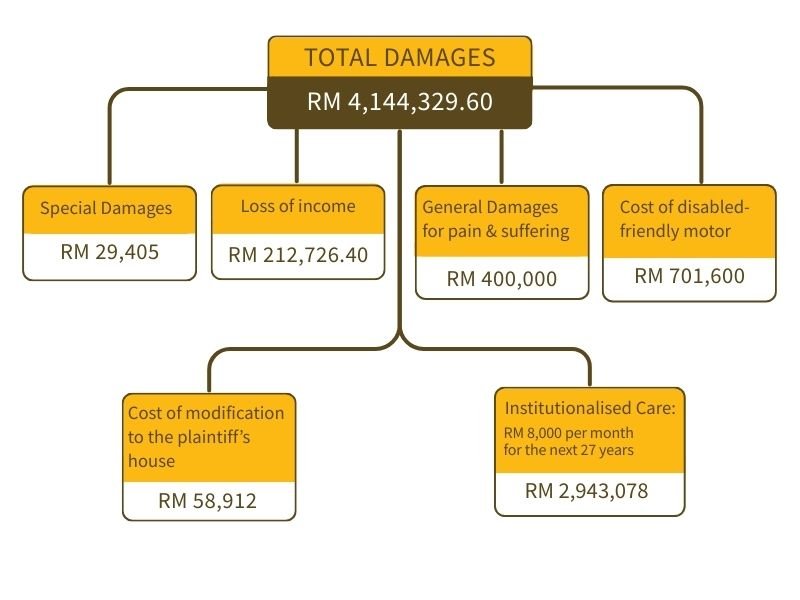
Reasons for Assessing Damages After Dismissing a Claim
Even when a plaintiff’s claim is dismissed, the trial judge remains obliged to assess damages. This is because any decision may be overturned on appeal, and if liability is later established, the appellate court may rely on the trial judge’s assessment without sending the case back for a delayed inquiry on damages.
This principle was recently affirmed by the Court of Appeal in Tan Sri Datuk Seri Mohd Hussein bin Abd Hamid v Gleneagles Hospital (Kuala Lumpur) Sdn Bhd & Anor [2025] 4 MLJ 339. By resolving both liability and quantum at first instance, the appellate process is streamlined: parties can challenge both issues in a single appeal, allowing the Court of Appeal to decide the case holistically.
This approach avoids unnecessary remittals, reduces delay, and prevents additional costs. Most importantly, it promotes finality and ensures that injured plaintiffs are not left waiting even longer for compensation if liability is ultimately established.
Conclusion
This case illustrates the Malaysian courts’ continued reliance on established medical opinion in evaluating standards of care, and the high threshold plaintiffs must overcome to prove causation in complex trauma cases, especially when it involves a case with other causative factors. The court’s willingness to assess over RM4.36 million in damages, despite dismissing the claim, underscores the importance of judicial efficiency in ensuring finality on both liability and quantum at first instance. Moreover, the assessment of damages is inherently a complex issue on its own, necessitating the courts to meticulously examine each specific item pleaded and substantiated by the plaintiffs’ evidence.
Beyond its outcome, the judgment highlights the ongoing tension between clinical discretion in emergency settings and the legal scrutiny of such decisions. As appellate courts revisit these issues, the contours of medical negligence law in Malaysia, particularly the scope and limits of judicial deference to medical opinion, remain open to further development.
Please contact us for a complimentary consultation to discuss your potential claim in medical negligence.
By Jeremy Balang and Joyce Wong
Note: This article does not constitute legal advice to any specific case. The facts and circumstances of each and every case will differ and therefore will require specific legal advice. Feel free to contact us for complimentary legal consultation.

