

The introduction of capital gains tax (CGT) in Malaysia in March 2024 has introduced a significant new layer of complexity for businesses involved in mergers, acquisitions, and internal restructurings. For public listed companies (PLCs), small-medium enterprises (SMEs), and their in-house counsel, the rules around share disposals and restructuring transactions now carry direct tax implications, making strategic oversight essential.
In this article, we explore how companies can effectively navigate Malaysia’s new capital gains tax framework, manage transaction risks, and structure deals to remain compliant while preserving value.
A Quick Overview of CGT in Malaysia
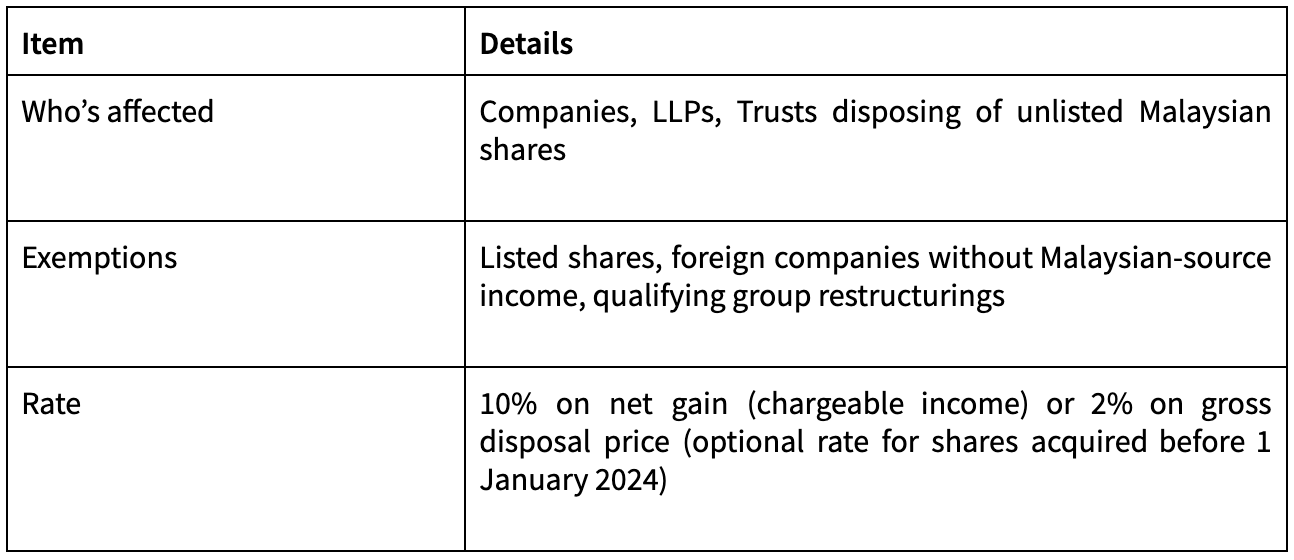
Under the Finance Act 2023, capital gains tax is now imposed on gains arising from the disposal of unlisted shares in Malaysian companies by non-individuals, such as companies, limited liability partnerships (LLPs), and trusts. The current rate stands at 10% on net gains, and applies to disposals occurring on or after 1 March 2024.
Capital Gains Tax at a Glance:
This change marks a departure from Malaysia’s traditional reliance on income tax and places Malaysia more in line with other ASEAN jurisdictions where capital gains are taxed routinely.
M&A Transactions: Legal and Tax Implications
Capital gains tax has made the sale of shares more complex for both sellers and buyers. For sellers, there’s now an immediate need to assess potential capital gains tax exposure, especially when historical acquisition cost records are unclear or outdated. For buyers, the implications may surface indirectly – through price adjustments, tax indemnities, or restructured deal terms.
It is now pertinent for due diligence in an M&A exercise to include:
- Verification of acquisition costs and holding periods;
- Seller’s tax residency and capital gains tax applicability; and
- Qualification for group exemptions (explained below)
Capital gains tax may shift the balance toward asset-based deals, especially where the seller is reluctant to absorb tax on capital gains. However, these alternatives can trigger stamp duty, licensing, and employment transfer issues – making a legal and commercial balancing act necessary.
The gain for capital gains tax is calculated based on the sale price minus the acquisition cost (sale price minus acquisition cost). Many companies, especially SMEs with legacy shareholdings, may face challenges substantiating original cost bases. In such cases, professional valuations are advisable to avoid tax disputes. The timing of the disposal event in M&As is critical, as discrepancies can affect both financial reporting and when tax filing obligations arise:
- Is it the signing date of the share sale agreement?
- The completion date?
- Or the payment date?
Stamp duty still applies to share transfers, creating a dual tax burden in many cases. While capital gains tax is levied on gains, stamp duty is based on transaction value, adding further structuring challenges.
Internal Restructurings: Exemptions and Considerations
Exemptions are available, but conditional. The Income Tax (Restructuring of Companies Scheme) (Exemption) Order 2024 and the Income Tax (Initial Public Offering) (Exemption) Order 2024 (collectively, the Exemption Orders) exempts a company, limited liability partnership (LLP), trust body or co-operative society from income tax on gains or profits from the disposal of unlisted shares in a Malaysian-incorporated company, to an acquirer company which is tax-resident in Malaysia. This exemption means local companies can reorganise ownership, merge, or streamline their structure without incurring tax and also fosters growth for Malaysian companies through acquisitions. The exemption effectively incentivises investment and ownership to stay within Malaysia, supporting domestic economic activity.
The Exemption Orders provide an exemption for internal group restructurings or in relation to the restructuring of any company for the purpose of an initial public offering (IPO), provided the acquiring companies are tax-resident in Malaysia. While helpful, this exemption is not automatic. Companies must carefully document the rationale, ensure proper shareholding structure, and maintain compliance over the 3-year window.
The following scenarios will now need careful consideration and structuring:
- Moving subsidiaries under a new holding company
- Spin-offs of non-core businesses
- Entity consolidations prior to IPOs or financing
Structuring Strategies to Mitigate CGT Impact
For in-house counsel and deal teams, the following strategies may help manage capital gains tax exposure effectively:
- Build tax modelling into early deal feasibility studies, including gain/loss calculations, potential exemptions and post-deal restructuring costs;
- Restructure shareholdings well in advance of transactions to ensure control and allow time to “season” the structure before disposal;
- Consider alternative deal mechanisms such as capital injections instead of share transfers, convertible instruments or call options to defer disposal;
- Embed capital gains tax indemnities, tax warranties, or retention clauses in the Share Sale Agreement (SSA) to allocate risk between buyer and seller.
Looking Forward
While the new capital gains tax framework does not extend to individuals, the question that lies ahead is whether the capital gains tax will eventually expand to individuals. The Inland Revenue Board (IRB) is expected to issue further guidance on the new capital gains tax framework for companies, and enforcement activity is likely to intensify in 2026. Proactive compliance and clean structuring are not just best practices – they are a legal necessity. Malaysia’s capital gains tax regime marks a significant shift for corporate structuring, and businesses can no longer approach M&A or internal reorganisations purely from a commercial lens.
Whether you’re an individual, a company preparing for a group restructuring, an SME considering a partial exit, or in-house counsel navigating deal mechanics, it is crucial to engage early with legal and financial advisors who understand the intersection of tax, corporate law, and transactional strategy.
We assist clients in structuring deals to minimise risk, leverage exemptions, and ensure regulatory compliance every step of the way. Feel free to reach out to our Corporate & Commercial M&A team should you have any questions.
Note: This article does not constitute legal advice to any specific case. The facts and circumstances of each and every case will differ and therefore will require specific legal advice. Feel free to contact us for complimentary legal consultation.

