


In this article, we examine the Court of Appeal’s recent decision in Dr Chandran a/l Gnanappah v Gan See Joe (suing as an administrator of the estate of Gan Hong Wee, deceased) & Anor (Civil Appeal No. B-02(NCvC)(W)-263-02/2023), focusing on the facts, the Court’s findings, key takeaways, and lessons for patients, families, and hospitals.
Background
This case arose from a tragic incident in 2014, in which the deceased passed away following a sinus surgery at a private hospital. The deceased’s family subsequently brought a negligence claim against both the attending ear, nose, and throat (ENT) surgeon and the hospital. After a full trial, the High Court found both the doctor and the hospital liable for medical negligence and awarded a total of RM1,241,686 in damages and costs to the deceased’s estate.
Dissatisfied with the outcome, both the ENT surgeon and the hospital appealed. The ENT surgeon challenged the findings of negligence and the quantum awarded, while the hospital argued that it should not be held liable for the actions of a non-employee consultant. Hearing both appeals together, the Court of Appeal largely upheld the findings of negligence but adjusted the indemnity between the ENT surgeon and the hospital.
Both the ENT surgeon and the hospital have since applied for leave to appeal to the Federal Court against the Court of Appeal’s decision.
Summary of Clinical Facts
On 27 March 2014, the patient was brought to the Accident and Emergency Department of a private hospital with neurological symptoms, including confusion, right lower limb weakness, blurred vision, vomiting of blood, and an episode of fits. A computed tomography (CT) scan of the brain revealed that all of the patient’s sinuses were almost completely filled with retained secretions. The attending medical officer referred the patient to a consultant neurologist, who diagnosed pansinusitis (infection of all four paranasal sinuses), suspected meningitis (infection of the brain lining), optic neuritis (inflammation of the optic nerves), and seizures. Intravenous antibiotics were started immediately.
A subsequent contrast-enhanced CT scan confirmed severe sinusitis involving all four sinuses. The patient was then referred to the ENT surgeon on call, the first defendant in the case.
That evening, the ENT surgeon examined the patient and filled out a guarantee letter request form addressed to the patient’s insurer, recommending functional endoscopic sinus surgery (FESS), also referred to as sinus surgery. This was done before any discussion took place with the patient’s family members. Later that night, an ophthalmologist assessed the patient and explained to the family that steroid treatment was being considered to address the optic neuritis but would only be administered after allowing 48 hours for the antibiotics to take effect.
On 28 March 2014, the ENT surgeon met with the patient’s parents and advised that the sinus infection was likely the source of the overall condition and that sinus surgery was necessary that same day. The surgery was performed at approximately 2:50 p.m. Shortly after the surgery, the patient became restless and delirious. He was intubated, placed on ventilatory support, and transferred to the hospital’s Intensive Care Unit (ICU), where he remained unconscious.
On 7 April 2014, due to financial constraints and exhaustion of his insurance coverage, the patient was transferred to a public hospital. A magnetic resonance imaging (MRI) scan performed there showed signs of encephalitis (inflammation of brain tissue). A second MRI scan on 18 April 2014 confirmed severe meningoencephalitis, indicating infection of both the meninges and the brain parenchyma. The deceased passed away on 30 April 2014. The cause of death was certified as encephalitis of unknown aetiology.
The Court of Appeal’s Decision
1) Negligence by the ENT Surgeon
The Court of Appeal affirmed the High Court’s finding that the ENT surgeon was negligent both in advising the deceased’s family and in performing the sinus surgery. The Court found that he had already decided to proceed with the sinus surgery, as evidenced by his submission of a guarantee letter request form to the insurer before consulting the deceased’s family.
The ENT surgeon also failed to inform the family that the procedure was elective, carried significant risks and that a safer and reasonable alternative was to allow time for the antibiotics to take effect. The sinus surgery was carried out only 17 hours after antibiotic administration, contrary to expert evidence, which recommended at least 24 hours. The use of general anaesthesia may have further compromised treatment efficacy.
The High Court also noted the ENT surgeon’s failure to await the results of an MRI scan or to consult with the neurologist and ophthalmologist, both of whom had recommended a more conservative approach. He further misrepresented the necessity of surgery and made inaccurate entries in the medical records to suggest that risks had been explained, an assertion contradicted by contemporaneous nursing notes.
Given these findings, the High Court held that the family’s consent was not informed and was therefore invalid. The High Court also held that the discharge against medical advice form, signed later by the deceased’s mother, had no bearing on the ENT surgeon’s liability.
2) Causation – the Surgeon’s Negligence Contributed to the Deceased’s Death
The Court of Appeal concluded that the ENT surgeon’s negligence materially contributed to the deceased’s death. If the family had been adequately informed, they would not have consented to the surgery, and the deceased’s death could have been avoided. Expert evidence confirmed that the sinus surgery was unrelated to the brain infection and could not have treated it. Performing the surgery prematurely disrupted antibiotic treatment and prevented the MRI scan that may have revealed the extent of the infection. The court held that, but for the ENT surgeon’s conduct, the death could have been avoided.
3) No Vicarious Liability for the Surgeon’s Negligence
The Court of Appeal found that the High Court erred in holding the hospital vicariously liable for the ENT surgeon’s negligence. The consultancy agreement between the parties clearly stated that the ENT surgeon was an independent contractor and not an employee or agent of the hospital. It also contained express provisions assigning responsibility for negligence to the ENT surgeon, requiring him to obtain his professional indemnity insurance, and confirming his independent status.
In this aspect, the Court of Appeal distinguished this case from Tan Sri Datuk Seri Mohd Hussein bin Abdul Hamid v Gleneagles Hospital (Kuala Lumpur) Sdn Bhd & Anor [2024] MLJU 3690, where no written agreement existed. In contrast, this case involved a clear contractual relationship that expressly excluded vicarious liability.
4) Breach of the Hospital’s Non-Delegable Duty of Care
The High Court in this case did not have the benefit of the Federal Court’s majority decision in Siow Ching Yee (suing through his wife and litigation representative, Chau Wai Kin) v Columbia Asia Sdn Bhd [2024] 3 MLJ 66. This Federal Court’s decision was delivered after the High Court had issued its grounds of judgment. However, the Court of Appeal in this case applied the modified Woodland test in light of the Private Healthcare Facilities and Services Act 1998 (“PHFSA”) and the Private Healthcare Facilities and Services Regulations 2006 (“PHFSR”).
The Court of Appeal held that the hospital had breached its non-delegable duty of care because:
a) The hospital had a statutory duty under section 31(1)(d) PHFSA and regulations 47(1) and 47(2)(b) PHFSR to obtain valid consent. Consent could only be valid if the family had been adequately informed of the material risks of surgery and available alternatives.
b) The deceased was a patient under the care and custody of the hospital, in a vulnerable position and reliant on the hospital for protection against medical harm.
c) There was an antecedent relationship from which a positive duty of care could be imputed.
d) The hospital did not control how the ENT surgeon discharged his responsibilities, whether through its employees or third parties.
e) The duty to obtain informed consent was effectively delegated to the ENT surgeon, but the hospital failed to ensure that this duty was properly discharged.
f) The ENT surgeon was negligent in carrying out that delegated statutory duty.
Shifting Full Liability to the ENT Surgeon – From 80% to 100% Indemnity
The Court of Appeal allowed the hospital’s appeal on its claim for an indemnity. It held that the ENT surgeon was 100% liable for the hospital’s liability to the deceased’s estate, reversing the High Court’s earlier finding of 80% contribution.
The court scrutinised the consultancy agreement, which expressly assigned liability for medical negligence to the ENT surgeon. It also applied section 10(1)(c) and (2) of the Civil Law Act 1956, which permits a tortfeasor to recover full indemnity from another where it is just and equitable.
The Court’s reasons included:
a) The ENT surgeon had induced the deceased’s family to consent to surgery through misrepresentation without the knowledge or involvement of the hospital.
b) He unilaterally decided to proceed with surgery without waiting for the antibiotic treatment to take effect or consulting other specialists.
c) His conduct was the sole cause of the harm for which the hospital was found liable under its non-delegable duty.
The Court of Appeal also rejected the ENT surgeon’s argument that the hospital’s own breach of duty barred indemnity. Accepting that argument would have contradicted the parties’ contractual allocation of risk and Parliament’s intention under section 10 of the Civil Law Act.
Summary of Damages Awarded
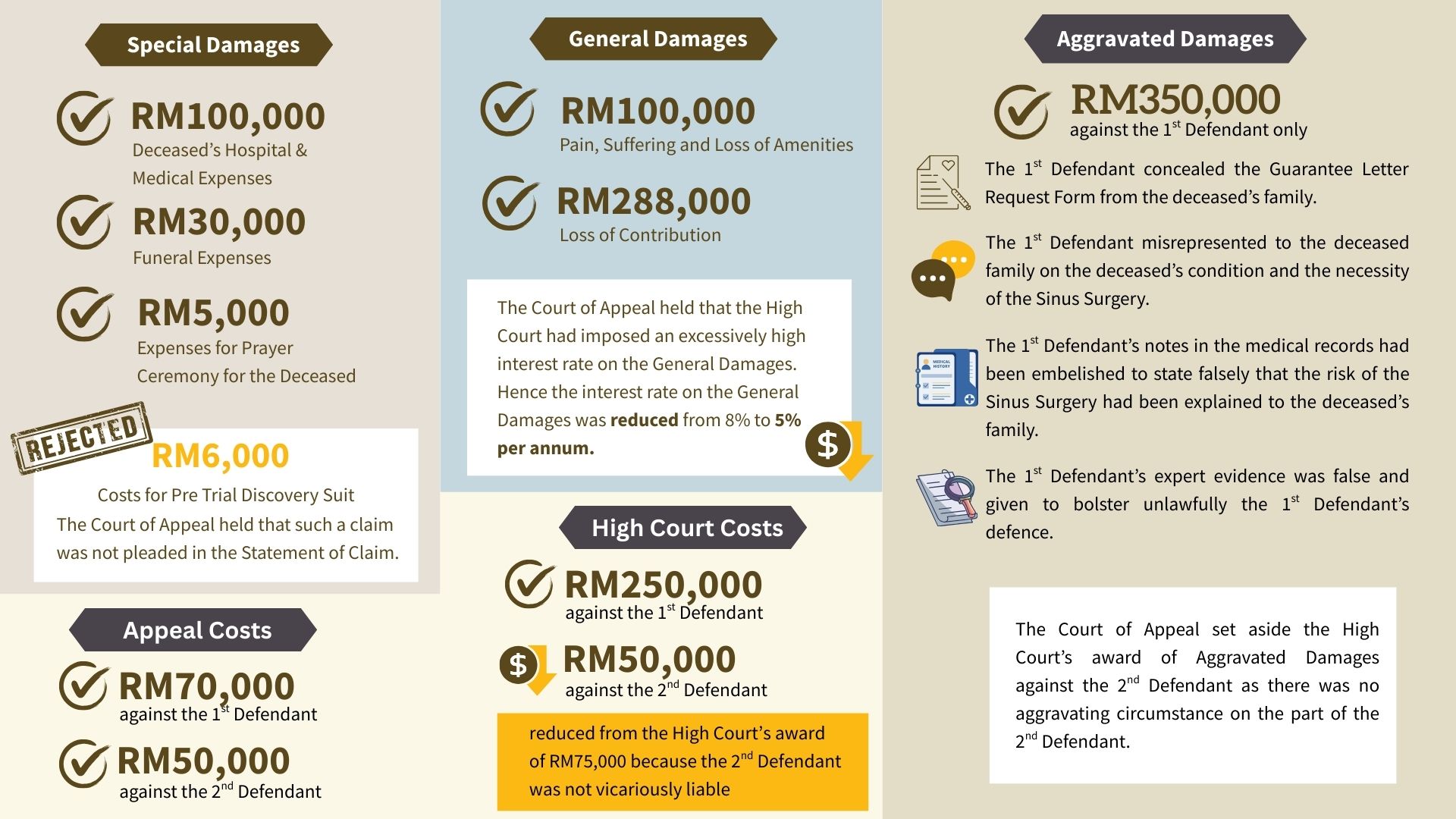
Conclusion
This case is a powerful reminder that informed consent is more than just a form; it is a legal and ethical safeguard that underpins safe and responsible medical care. Patients and their families have the right to understand the nature of a proposed treatment, its risks, and whether safer alternatives are available. When that right is overlooked or inadequately respected, the consequences can be life-altering.
The Court of Appeal’s decision also highlights the evolving legal standards on hospital liability in Malaysia. While doctors may be engaged as independent consultants, private hospitals remain subject to statutory duties that cannot be delegated or avoided through contractual arrangements. These include the duty to ensure that valid, informed consent is obtained and that vulnerable patients are adequately protected from foreseeable harm.
At the same time, findings on liability are not automatic. The court’s approach demonstrates that each case is highly dependent on its own facts, particularly the nature of the hospital’s relationship with the treating consultant and the role it played in the patient’s care.
For patients and families, this case reinforces the importance of asking questions, seeking second opinions, and making fully informed decisions about treatment. For doctors and healthcare providers, it serves as a cautionary reminder of the need to uphold professional standards, maintain accurate documentation, and respect patients’ rights to make informed choices.
If you or a loved one has suffered harm following medical treatment and is unsure whether it amounts to medical negligence, we encourage you to reach out. Our experienced medical negligence lawyers can help you understand your rights and guide you through your options with clarity and care.
By Jeremy Balang and Jason Lim
Note: This article does not constitute legal advice to any specific case. The facts and circumstances of each and every case will differ and therefore will require specific legal advice. Feel free to contact us for complimentary legal consultation.

