

The legal framework governing public assemblies in Malaysia has undergone a significant constitutional evolution. What began as a permit-based regime under the Police Act 1967 – which vested broad discretion in the police to approve or deny gatherings – was replaced in 2012 by a notification system under the Peaceful Assembly Act 2012 (“PAA 2012”). This legislative shift signalled an intention to recalibrate the balance between public order and the constitutional right to assemble.
Yet the transformation was incomplete. While the Peaceful Assembly Act 2012 removed the requirement for prior police permits, section 9(5) PAA 2012 criminalised the failure to provide advance notice of an assembly. This gave rise to a fundamental constitutional question: when does regulation of a right become a prohibition of it? More specifically, was the imposition of criminal liability for non-notification a permissible “restriction” under Article 10(2)(b) of the Federal Constitution, or did it operate in substance as a disproportionate suppression of the right to peaceful assembly?
In Amir Hariri bin Abd Hadi v Public Prosecutor [2025] 4 MLJ 807, the Federal Court resolved a decade-long judicial conflict and declared section 9(5) PAA 2012 unconstitutional. The decision does more than invalidate a statutory provision. It clarifies the constitutional limits of legislative power under Article 10, reaffirms the centrality of proportionality in rights adjudication, and reshapes the legal landscape governing public assemblies in Malaysia.
This article traces the historical development of assembly law from the Police Act 1967 to the Peaceful Assembly Act 2012, examines the conflicting Court of Appeal authorities that preceded Amir Hariri, analyses the Federal Court’s reasoning, and considers the practical implications of the decision for organisers and public authorities alike.
Constitutional Right to Peaceful Assembly
Article 10(1)(b) of the Federal Constitution guarantees all citizens the right to assemble peaceably and without arms. It is one of the fundamental liberties protected under Part II, reflecting the constitutional recognition that collective expression forms part of democratic participation.
However, this right is not absolute. Under Article 10(2)(b), Parliament may impose such restrictions as it deems necessary or expedient in the interests of the security of the Federation or public order. Legislative regulation is therefore permissible, but only within constitutional limits.
Malaysian jurisprudence has established that restrictions on fundamental liberties must satisfy the doctrine of proportionality, grounded in Article 8(1). Measures that are arbitrary, excessive, or disproportionate to their objective fall outside Parliament’s constitutional competence.
The constitutional inquiry thus centres on the boundary between regulation and suppression. While Parliament may regulate the manner in which assemblies are conducted, a measure that effectively deters or prevents the meaningful exercise of the right risks amounting to an unconstitutional prohibition rather than a lawful restriction.
Police Act 1967 – The Permit Regime
Prior to the enactment of the Peaceful Assembly Act 2012, public assemblies were principally governed by sections 27 to 27C of the Police Act 1967. The statutory framework imposed a permit requirement for any assembly, meeting or procession involving more than three persons. In practice, this meant that the exercise of the constitutional right to assemble was contingent on prior police approval.
The police were vested with broad discretion in determining whether to grant or refuse a permit. A gathering held without a permit, even if entirely peaceful, constituted an offence. Participants could be arrested without a warrant, and organisers could face criminal liability. The regime therefore operated not merely as a regulatory mechanism, but as a system of prior restraint.
Although Article 10(2)(b) permits Parliament to impose restrictions in the interest of public order or security, the permit system under the Police Act 1967 effectively converted a constitutional right into a privilege dependent upon executive discretion. The ability to assemble was not presumed; it had to be authorised.
Over time, this framework attracted sustained criticism on the basis that it vested excessive power in the executive and constrained meaningful civic participation. The perception that the permit requirement functioned as a barrier rather than a facilitative mechanism contributed to the legislative shift that followed. The introduction of the Peaceful Assembly Act 2012 was intended to recalibrate this balance by replacing prior authorisation with a notification regime.
Peaceful Assembly Act 2012 – From Permits to Notification
The Peaceful Assembly Act 2012 (“PAA 2012”) replaced the permit regime under section 27 of the Police Act 1967 with a notification-based framework. Its enactment marked a structural shift in how the right to assemble was regulated. Instead of requiring prior authorisation, the Act presupposed that assemblies may proceed, subject to compliance with statutory procedures and conditions.
Section 2 sets out the objects of the Act. It affirms that citizens have the right to organise and participate in assemblies peaceably and without arms, while recognising that the exercise of that right is subject to restrictions deemed necessary or expedient in a democratic society in the interests of security or public order. The statutory language mirrors the constitutional balance under Article 10(2)(b).
Section 9(1) – Requirment of 10 day’s Notice
Section 9(1) of the Peaceful Assembly Act 2012 requires an organiser to notify the Officer in charge of the relevant police district at least 10 days before the date of the assembly.
The statutory scheme is framed as a notification requirement rather than an application for a permit. Unlike the regime under the Police Act 1967, the Act does not confer on the police a power to grant or refuse approval for an assembly. The obligation imposed on the organiser is to provide advance notice of the proposed event.
Under section 14, the Officer in charge must respond within five days of receiving the notification. In that response, the officer may impose restrictions and conditions pursuant to section 15. If no response is issued within the prescribed period, the assembly may proceed as set out in the notification.
Restrictions and Conditions
Section 15 empowers the police to impose conditions in the interests of national security, public order or morality. These may relate to matters such as the date, time, duration and place of the assembly, the manner in which it is conducted, the conduct of participants, clean-up obligations, and sensitivities connected to the chosen venue.
Non-compliance with restrictions imposed under section 15 constitutes an offence punishable by a fine of up to RM10,000. An organiser aggrieved by such conditions may appeal to the Minister under section 16 within 24 hours, and a decision must likewise be made within 24 hours of receipt.
Section 9(5) – Criminalisation of Non-Notification
Notwithstanding the shift to a notification regime, section 9(5) introduced a criminal sanction for failure to comply with section 9(1). An organiser who failed to provide the required 10-day notice committed an offence punishable by a fine of up to RM10,000.
It was this penal consequence – rather than the notification requirement itself – that became the focal point of constitutional challenge. While the Act formally moved away from executive authorisation, the imposition of criminal liability for non-notification raised the question whether the statutory scheme, in substance, continued to operate as a deterrent to the exercise of the right to assemble.
Nik Nazmi v PP [2014]
The Court of Appeal in Nik Nazmi bin Nik Ahmad v Public Prosecutor [2014] 4 MLJ 157set aside the conviction of an organiser of an indoor public assembly for failing to notify the police ten days before the event.
Mr Nik Nazmi, a Selangor State Assemblyman, organised a post–GE13 rally at Stadium MBPJ on 8 May 2013. He notified the police on the same day, falling far short of the 10-day advanced notice requirement under s 9(1). He was charged under s 9(1) and punished under s 9(5).
The Court of Appeal observed that while the 10-day notice requirement was reasonable, Section 9(5) was unconstitutional as it prohibited, without justification, urgent and spontaneous assemblies. The Court of Appeal held that the PAA 2012 does not render an assembly unlawful merely because the organiser failed to provide the 10-day notice. The court emphasised that there is no provision in the Act stating that an assembly held without prior notice is per se unlawful, and therefore, criminalising an organiser under section 9(5) for a peaceful assembly solely due to an administrative omission is disproportionate and unconstitutional.
Moreover, it was held that a lawful act would not be an unlawful act merely for an administrative failure or omission on the organiser’s part. It was held that there is no reasonable and rational nexus or connection between the requirement for the 10-day notice and the objective of maintaining security in the Federation or any part thereof or public order.
Nik Nazmi became the first appellate court judgment to invalidate s 9(5), holding it ultra vires the Constitution. However, its effect was short-lived due to the later decision of the Court of Appeal in Yuneswaran.
PP v Yuneswaran [2015]
In the following year, the Court of Appeal in PP v Yuneswaran [2015] 6 MLJ 47 departed from the finding in Nik Nazmi. The respondent, the executive secretary of PKR Johor Bahru, organised a party gathering at PKR’s office without giving the police the 10-day notice under s 9(1). He argued that he was not the organiser. The Sessions Court convicted him; the High Court acquitted him solely because it felt bound by Nik Nazmi, which had declared s 9(5) invalid. The Court of Appeal overturned this decision and found that the punishment for the failure to give notice of 10 days is constitutional.
The Court of Appeal held that the criminal sanction in section 9(5) PAA 2012 is constitutionally valid, as it forms part of Parliament’s power to regulate the exercise of the right to peaceful assembly. The court emphasised that Article 10(2)(b) does not prohibit Parliament from prescribing criminal penalties for non-compliance with procedural requirements, and therefore, the imposition of a fine for failing to give advance notice does not amount to a restriction on the right itself but a regulatory measure within legislative competence.
Yuneswaran reinstated the full enforceability of s 9(5). For years, this decision formed binding precedent, causing organisers to face criminal penalties for non-notification.
Maria Chin bt Abdullah v PP [2016]
Subsequently, the case of Maria Chin bt Abdullah lwn Pendakwa Raya [2015] 6 MLJ 47 applied the principles in Yuneswaran, which is to be adopted in future cases as opposed to the principles in Nik Nazmi.
Ms Maria Chin, as chairperson of Bersih 2.0, helped organise Bersih 4 in August 2015. Although Bersih wrote a central letter to the Inspector-General of Police, she did not specifically notify the Brickfields OCPD as required under s 9(1). She was charged under s 9(1), punishable under s 9(5). She sought to strike out the charge on the grounds that Nik Nazmi had already invalidated s 9(5).
The High Court in this case had the chance to consider both Nik Nazmi and Yuneswaran and found that both cases decided by the Court of Appeal were applicable. However, the High Court took the view that due to the existence of two conflicting Court of Appeal rulings regarding Section 9(5) of the Act, in accordance with the legal principle of stare decisis and the doctrine of judicial precedent, the later decision in the case of Yuneswaran on this matter took precedence over the previous precedent set in the case of Nik Nazmi.
Maria Chin cemented the position that Yuneswaran was the binding authority, meaning s 9(5) continued to be enforceable nationwide until the Federal Court finally resolved the conflict in 2025.
How These Cases Fit Into the Legal Evolution of the PAA 2012
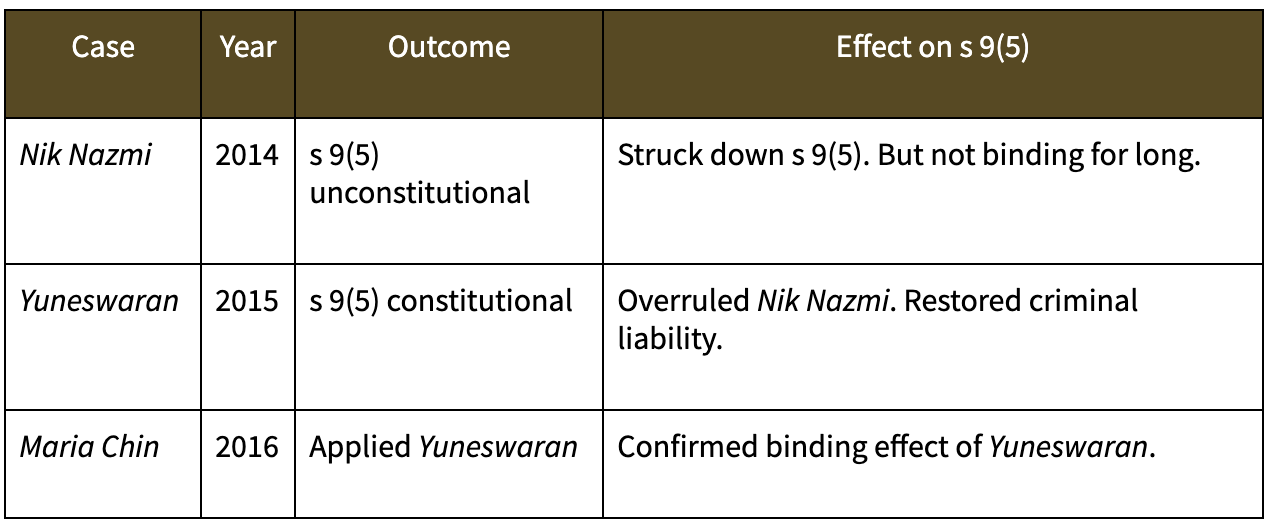
This decade-long conflict created legal uncertainty until the Federal Court’s final decision in Amir Hariri, which declared s 9(5) unconstitutional once and for all.
The Federal Court’s Landmark Ruling in Amir Hariri
The applicant, co-founder and member of the Malaysian United Democratic Alliance (MUDA) had organised a peaceful rally in central Kuala Lumpur on 14 August 2022 to protest the government’s award of a defence contract. The rally, attended by around 60 people, proceeded without incident, yet 12 days later he was charged under section 9(5) for failing to notify the police 5 days prior to the event, as required by section 9(1). On 1 July 2025, the Federal Court unanimously declared section 9(5) PAA 2012 unconstitutional, striking it down under Article 4(1) of the Federal Constitution. This is now the definitive position on this constitutional issue.
Below is a distilled analysis of the Court’s reasoning.
1. Proportionality and Article 8(1)
The Federal Court reaffirmed that although Article 10(2)(b) permits restrictions, such restrictions must pass the proportionality test grounded in Article 8(1) (equality before the law). Relying on Sivarasa Rasiah v Badan Peguam Malaysia & Anor [2010] 2 MLJ 333, Public Prosecutor v Azmi bin Sharom [2015] 6 MLJ 751 and Alma Nudo Atenza v Public Prosecutor and another appeal [2019] 4 MLJ 1, the Court held that “legislation restricting fundamental liberties must be objectively fair and proportionate to its aim”.
2. Section 9(5) Is a Disproportionate and Discriminatory Restriction
Section 9(5) failed proportionality for several reasons:
a. It criminalises peaceful assemblies: An organiser can be prosecuted even if the assembly was entirely peaceful.
b. It discriminates between organisers and participants: Participants face no liability; organisers alone shoulder criminal risk. Such differential treatment lacked justification.
c. It effectively prohibits urgent assemblies: Assemblies requiring a rapid response (e.g., public outrage, sudden policy actions) become impossible if the organiser must risk prosecution.
d. It exerts a severe chilling effect: Fear of prosecution discourages organisers from initiating assemblies entirely.
e. It has no nexus to public order: The police already possess extensive powers under s 15, s 20, s 21 PAA and Chapter VIII Penal Code to address disorderly conduct.
3. Section 9(5) Is a Prohibition – Not a Restriction
The Federal Court drew a sharp distinction between restriction (regulates how a right is exercised) and prohibition (denies the ability to exercise the right at all). Since section 9(5) deters or prevents the organisation of legitimate assemblies, it functions as a prohibition, and therefore exceeds Parliament’s power under Article 10(2)(b).
4. Yuneswaran Overruled; Nik Nazmi Affirmed
The Federal Court expressly overruled Yuneswaran, confirming Nik Nazmi as correctly decided.
Practical Impact of Amir Hariri
The Federal Court’s decision in Amir Hariri marks a decisive shift in Malaysia’s peaceful assembly landscape. By striking down section 9(5) of the Peaceful Assembly Act 2012, the Court has removed the criminal penalty previously imposed on organisers who failed to provide advance notice under section 9(1). As a result, failure to notify the police can no longer expose organisers to prosecution, and the absence of notice cannot be treated as transforming a peaceful assembly into an unlawful one.
This development has particularly significant implications for spontaneous or urgent assemblies, which were previously deterred by the threat of criminal liability. Such assemblies, often reflective of immediate public sentiment or rapid developments, now enjoy stronger constitutional protection. The ruling acknowledges that democratic participation sometimes requires immediacy, and the law must not impose barriers that effectively silence legitimate public expression.
In this new legal environment, the role of the police is also recalibrated. While law enforcement retains the authority to regulate assemblies through restrictions under section 15 of the Act, its approach must now be facilitative rather than prohibitive. The absence of notice cannot be used as the sole basis for investigations, arrests, or enforcement action. Police practice must align with the Federal Court’s clarification that the notification regime is administrative in nature and cannot be used to criminalise constitutionally protected behaviour.
Importantly, the ruling does not absolve organisers of all responsibilities. Section 6 PAA 2012 continues to impose obligations relating to safety, crowd control, and cooperation with authorities. Organisers must still take reasonable steps to ensure that assemblies remain peaceful and that the rights and freedoms of others are respected. Thus, while the removal of penal consequences under section 9(5) strengthens constitutional protections, it also underscores the importance of responsible and well-coordinated public assemblies.
Overall, the Federal Court has restored balance to the statutory framework: peaceful assemblies cannot be criminalised for mere administrative non-compliance, yet organisers and authorities must continue to work collaboratively to ensure that the right to assemble is exercised safely and meaningfully within Malaysia’s democratic fabric.
Organising a Peaceful Assembly post-Amir Hariri
To organise a peaceful assembly in adherence to the legal requirements post Amir Hariri, the organiser of any assembly will still have to notify the Officer in Charge of the relevant Police District. The notification, made under subsection 9(1) of the Peaceful Assembly Act 2012, must:-
a. be in the form in the Fourth Schedule a copy of which is attached below for reference;
b. be signed by the organiser;
c. be accompanied by a copy of the consent of the owner or occupier of the place of assembly; if applicable; and
d. be accompanied by any additional document as may be specified by the Officer in charge of the police District, if any.
In addition to the notification requirements, organisers must fulfil the responsibilities as outlined in Section 6 PAA 2012, amongst which are:-
(a) ensure that the organisation and conduct of an assembly is not in contravention of this Act or any order issued under this Act or any other written law;
(b) ensure that he or any other person at the assembly does not do any act or make any statement which has a tendency to promote feelings of ill-will or hostility amongst the public at large or do anything which will disturb public tranquillity;
(c) ensure that he or any other person at the assembly does not commit any offence under any written law;
(d) ensure that the organisation and conduct of an assembly is in accordance with the notification of assembly given under subsection 9(1) and any restrictions and conditions which may be imposed under section 15;
(e) appoint such number of persons as he thinks necessary to be in charge of the orderly conduct of the assembly;
(f) cooperate with the public authorities;
(g) ensure that the assembly will not endanger health or cause damage to property or the environment;
(h) ensure that the assembly will not cause any significant inconvenience to the public at large;
(i) ensure the clean-up of the place of assembly or bear the clean-up cost of the place of assembly; and
(j) in the case of simultaneous assemblies or counter assemblies, ensure that the organisation of the assemblies are not intended to specifically prevent the other assembly from taking place or interfere with the organisation of such assembly.
Conclusion
The right to assemble peaceably and without arms remains a constitutionally protected liberty under Article 10(1)(b). The Federal Court’s decision in Amir Hariri clarifies the constitutional limits of legislative power in regulating that right. By declaring section 9(5) unconstitutional, the Court affirmed that procedural non-compliance cannot, without more, justify criminal sanction where the assembly itself is peaceful.
The decision reinforces proportionality as the governing principle in the restriction of fundamental liberties. Parliament may regulate the manner in which assemblies are conducted in the interests of security and public order, but measures that operate in substance as a deterrent to the exercise of the right will not withstand constitutional scrutiny.
In the post-Amir Hariri landscape, organisers must continue to comply with statutory responsibilities under the Peaceful Assembly Act 2012, and the authorities retain regulatory powers under the Act and other written laws. The constitutional balance lies not in the absence of regulation, but in ensuring that regulation remains proportionate, even-handed and consistent with the rule of law.
For advice on compliance obligations, enforcement risks, or issues arising under the Peaceful Assembly Act 2012, our criminal law team is available to assist.
Note: This article does not constitute legal advice to any specific case. The facts and circumstances of each and every case will differ and therefore will require specific legal advice. Feel free to contact us for complimentary legal consultation.

